The Claims Compliance Tools Miss, And Why They Matter More Than the Ones They Catch
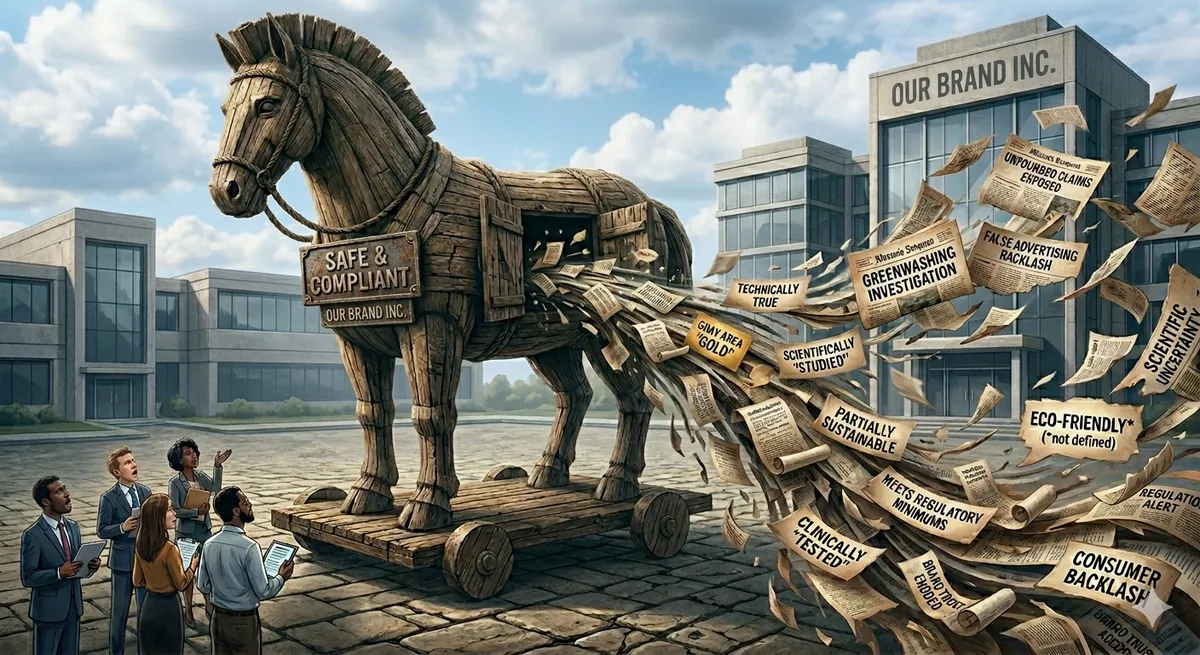
Most compliance tools can tell you if your marketing copy breaks a regulation. Yet the claims most likely to damage your brand aren't the ones that break the law. They're the ones that mislead your customers without technically crossing a legal line.
This is the gray area, and it deserves far more attention than it gets.
The Compliance Blind Spot
The compliance industry has built an impressive toolkit for catching regulatory violations. If your ad copy runs afoul of FINRA, the FTC, or the EU Green Claims Directive, there's software for that. These tools scan your content against rule libraries, flag violations, and suggest compliant alternatives. They're fast, they're useful, and they solve a real problem.
They only solve half the problem.
There's an entire category of claims that sail through regulatory checks and still blow up in your face. The product described as "sustainably sourced" based on one minor input. The supplement that's "clinically tested" because it appeared in a single, underpowered study. The packaging that says "eco-friendly" without defining what that actually means.
None of these might trigger a regulatory flag. But any of them can trigger a consumer backlash that costs far more to recover from than a fine.
Why Gray Area Claims Are More Dangerous Than Illegal Ones
When you violate a regulation, the consequences are at least predictable: a warning letter, a fine, maybe a mandated correction. It's painful, but it's contained. You know the process. You have legal counsel for exactly this scenario.
Gray area claims don't follow that script.
When a consumer spots something that feels misleading, when a Reddit thread dissects your "natural" label and finds it's mostly marketing theatre, there's no formal process to manage it. There's no regulatory body mediating the conversation. Instead, it plays out publicly: social media threads, journalist inquiries, retailer questions, and a trust deficit that takes real time to rebuild.
The data backs this up. According to the Edelman Trust Barometer, 71% of consumers say they lose trust in a brand instantly if they perceive it as putting profit over people. And once that trust breaks, 53% refuse to purchase and 38% actively warn friends and family. That's not a compliance event. It's a brand experience problem.
The scale of this challenge is worth understanding. 70% of consumer products now carry environmental claims, averaging 2.2 claims per product. Yet 59% of those claims have no easily accessible supporting evidence. And there's a striking disconnect: 90% of executives believe consumers trust their brand, while only 30% of consumers actually do. That 60-point perception gap is one of the biggest unaddressed issues in modern brand management.
Why Existing Tools Can't Catch This
Traditional compliance technology is built around a clear model: there's a rule, and your content either passes or fails against that rule. This works brilliantly for heavily regulated industries where the boundaries are defined, like financial services, pharmaceuticals, and healthcare.
Most consumer-facing brands don't operate in that world. Fashion, food, beauty, wellness, supplements: these sectors sit in a lightly regulated space where the line between a defensible claim and a misleading one isn't drawn by a regulator. It's drawn by your customer's expectations.
Customer expectations don't live in a rule library. They shift with culture, with social media discourse, with the latest expose on greenwashing in fast fashion. A claim that felt acceptable two years ago might feel tone-deaf today. A claim that's technically accurate might still be perceived as deceptive because it omits context that consumers would consider material.
This is the gap that no amount of regulatory scanning can close. You need a fundamentally different approach, one that doesn't just ask "is this legal?" but asks "is this genuinely truthful, defensible from every angle, and aligned with how a real person will interpret it?"
Assessing Claims From Every Angle
At PocketSeed, we built our framework around this exact challenge. Rather than checking claims against a static list of rules, we assess them through multiple lenses, what we call a multi-value approach to claim readiness.
This means evaluating a claim not just for regulatory compliance, but across several dimensions simultaneously. What does the evidence actually support, and does the wording accurately reflect that evidence? Is there internal alignment: do your scientists, product teams, and marketers all agree on what can credibly be said? If a journalist, a regulator, or a sceptical consumer asked you to defend this claim tomorrow, could you? And critically, how will your audience perceive this claim, not what you intended it to mean, but what they'll actually take away from it?
That last dimension is where most brands get caught out. You might claim your packaging is "biodegradable" and have evidence to support it, but if your customer assumes that means their home compost bin, and the reality is it requires an industrial facility, you have a perception gap that no amount of technical accuracy will fix once it surfaces publicly.
Our approach catches these gaps before they become headlines. Each claim is linked to its supporting evidence, assessed for consistency and credibility, and pressure-tested against how it will land with real people. The result isn't just a compliance check. It's a defensibility assessment that holds up under scrutiny from any direction.
From Fragile Claims to Brand Currency
What often gets lost in the compliance conversation is that this isn't just about avoiding risk. Done right, claim integrity is one of the most powerful brand-building tools available to marketing leaders today.
The reason is simple: we're in an era where consumers are doing their own research. 62% of Gen Z and Millennials actively investigate claims before purchasing. They're using apps like Yuka and Think Dirty to scan products. They're reading ingredient lists on TikTok. They're crowdsourcing product reviews in group chats. The old model of making a bold claim, putting a badge on the packaging, and hoping nobody looks too closely is dead.
The flip side of this scepticism is that consumers are hungry for brands they can actually trust. 54% are willing to pay more for products with verified claims. Companies that track trust as a board-level KPI are three times more likely to report stronger profits. Trust isn't a soft metric. It's a growth lever.
When your claims are genuinely backed by evidence, something remarkable happens. Your customers don't just buy, they advocate. They become what Seth Godin calls "sneezers," spreading your story because they believe in it. A verified claim isn't a liability to be managed; it's a story worth sharing. And in a market drowning in unsubstantiated noise, a brand that can actually show its receipts stands out.
The Regulatory Tailwind
This shift isn't just consumer-driven. The regulatory landscape is tightening fast.
The EU Green Claims Directive will impose fines of at least 4% of annual revenue for misleading environmental claims. Digital Product Passports are coming, requiring brands to prove provenance and composition in ways that static labels never could. The FTC's Operation AI Comply is putting AI-powered marketing claims under the microscope. And these are just the headline regulations. The broader trend is unmistakable.
For marketing leaders, this is actually an opportunity. The brands that build evidence-backed claims into the DNA of how they go to market will own the trust advantage in their category. They'll move faster because their claims are pre-substantiated. They'll spend less time on reactive issues because they've addressed the gray area risk before launch. And they'll build the kind of durable brand equity that compounds over time.
A Different Kind of Support
PocketSeed exists because we believe the companies doing genuinely good work deserve better than a binary compliance check. They deserve a system that helps them tell their story with confidence, backed by structured evidence, assessed from every angle, and ready to withstand scrutiny from regulators, consumers, and competitors alike.
We're not here to police your marketing. We're here to make your marketing bulletproof, so you can make bolder claims with more confidence, not fewer claims with more fear.
Because in a market where 68% of executives admit to greenwashing and consumers are more sceptical than ever, the brands that win won't be the ones with the cleverest copy. They'll be the ones that can prove every word.